
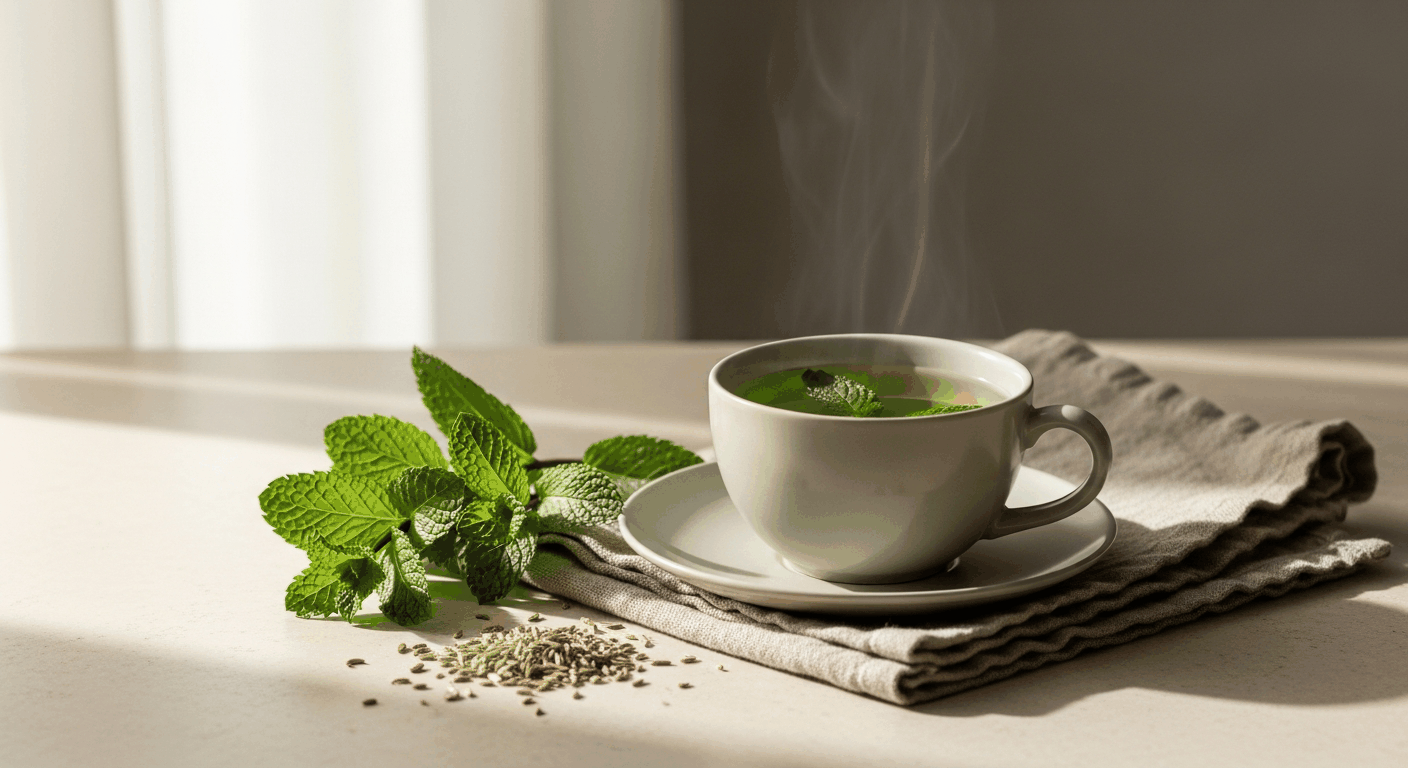
Podina and the Art of Hazm: Why Mint Closes a Pakistani Meal
That capful of arq-e-podina after Sunday's nihari was not a quaint habit. It was Unani thinking about hazm, applied at the table — and knowing whether to reach for arq, sharbat or chutney changes what it actually does.
It is half past two on a Sunday afternoon and the nihari has been scraped down to the last piece of nalli. Someone reaches for the water jug; your grandmother reaches instead for a small bottle at the back of the fridge, pours a capful into a glass, tops it up with water and passes it round without a word of explanation. That capful of arq-e-podina was not a garnish and not a habit picked up from a television advertisement — it was the closing step of the meal, as deliberate as the baghar that opened it.
Hazm is a fire, not a machine
Modern nutrition describes digestion in terms of enzymes and transit time. Unani medicine — the tradition we have been compounding within in Multan since 1998 — describes hazm, and it pictures the stomach not as a mill but as a cooking pot set over a flame. That flame is hararat-e-ghareezia, the body’s innate heat. Food arrives raw and thick; if the fire is steady and the pot is not overloaded, what leaves the stomach is fine, properly cooked matter that the liver can carry forward.
Almost everything that goes wrong follows from that image. Overload the pot and the fire cannot reach the middle: food sits, ferments and produces riyah — wind, the pressure under the ribs that has you quietly loosening the cord of your shalwar after a wedding dinner. Pour iced water onto the fire straight after a heavy meal and the cooking stalls halfway. Let the fire burn fiercely on an empty stomach and you get the sour rising in the throat at four in the morning. The hakeem’s term for the whole family of complaints is su-e-hazm, badly done digestion, and it is addressed by correcting conditions rather than silencing symptoms.
This is why traditional prescribing is so preoccupied with timing. The same herb taken before food, with food and after food is understood to be doing three different jobs — sharpening appetite, assisting the cooking, or clearing away what was left behind.
Why our food asks for help
Consider what an ordinary Pakistani table actually holds. Meat cooked for hours in desi ghee. Onions browned to the point of collapse. Rice enriched with the fat that rose to the top of the degh. Then, at five o’clock, samosas fried in oil that has had a long working day, and a bowl of chaat combining chickpeas, potato, yoghurt and tamarind all at once. In Unani terms most of this is ghaliz — thick, heavy, slow. It is magnificent food. It is also not light work for a stomach.
Season makes it harder still. In a Multan June the appetite thins and the innate heat is described as being drawn outward to the skin, leaving the digestive fire weaker at exactly the moment the household is drinking three litres of chilled water a day. In the monsoon weeks the complaint changes shape entirely — dampness, unsettled stomachs, food that turns between the shop and the kitchen. In winter the fire is stoked and appetites return, which becomes its own problem during a wedding season of four dinners a week.
The stomach is the house of every illness, and restraint is the head of every remedy — a saying repeated in hakeems’ clinics long before anyone thought to count a calorie.
Where podina earns its place
Podina — mint — occupies an unusual position in the cupboard. It reads as cooling on the tongue and is classed as cooling in temperament, yet it does not dull or dampen the way a purely cold remedy would. It disperses. In the traditional vocabulary it is kasir-e-riyah, a breaker of wind, and mufarreh, something that lifts the spirits. A pharmacologist would point instead at mint’s volatile oils and their relaxing effect on smooth muscle. The two descriptions are looking at the same experience from opposite ends of the room.
That combination is precisely what makes podina a herb for closing a meal rather than opening one. It eases the pressure of trapped wind, it settles the queasiness that comes with richness, it cuts the greasy coating a plate of biryani leaves behind, and it does all of this without adding heat to a body already sitting in forty-four degrees.
It almost never works alone. The classical formulas keep it in company:
- Ajwain (carom) — warming and sharp, the counterweight when the stomach feels cold and cramping rather than hot and full.
- Saunf (fennel) — sweet and cooling, chewed after meals in very much the same role as podina.
- Kala namak (black salt) — the sulphurous note in every good chutney, valued for appetite and for cutting heaviness.
- Zeera (cumin) — roasted and ground, the third member of the chutney trio.
- Elaichi (green cardamom) — aromatic and cooling, the finishing note in sharbats and on the paan tray.
- Adrak (ginger) — warming, for the heavy meal eaten in cold weather.
Three podinas, three different jobs
This is where most households get confused, because all three live in the same kitchen and all three taste of mint. They are not interchangeable.
Arq-e-podina is a steam distillate. Fresh mint is packed into a still with water, the vapour is condensed, and what collects is a clear, faintly aromatic water carrying the volatile fraction of the plant and very little else — no sugar, no pulp, no fibre. It is thin, it is quick, and it is the form to reach for when the discomfort is immediate. Our arqiyat range is built on this method; the same still turns out arq-e-badiyan, arq-e-ajwain and arq-e-gulab.
Sharbat-e-podina is a syrup — mint extract carried in sugar, cooked down and preserved. The sugar changes two things. It lets the bottle keep for months in a Pakistani pantry, and it slows the whole preparation into a sweet, mild sipping drink rather than a corrective. It belongs on the summer trolley beside the other sharbats rather than in the medicine cupboard.
Podina chutney is the whole leaf, ground with green chilli, garlic, cumin and salt. It carries the fibre and the pungency, and it is eaten with the food — which places it in the appetite-and-assistance role rather than the after-the-fact one.
| Preparation | What it actually is | Traditionally taken | Suits |
|---|---|---|---|
| Arq-e-podina | Steam distillate; no sugar, no pulp | A capful in half a glass of water, after eating | Heaviness, trapped wind, queasiness after rich food |
| Sharbat-e-podina | Mint extract in sugar syrup | Diluted one part to six or seven, through the afternoon | Summer thirst; a cooling drink for guests |
| Podina chutney | Fresh leaf ground with salt, chilli and zeera | Alongside the meal itself | Appetite; cutting the richness of fried food |
| Safoof containing podina | Dried herbs milled and blended | A small spoon with warm water after dinner | Ordinary, repeated sluggishness rather than one bad meal |
The blended powders — our safoof range — sit slightly apart from the other three. A powder holds the dried plant entire, nothing extracted and nothing discarded, which is why traditional prescribing reaches for it in the slow everyday complaint rather than the sudden one.
Reading the signal before choosing the remedy
A hakeem will always ask what the discomfort feels like before deciding what to hand over, and it is a useful habit to borrow at home. Broadly:
- Tight and full under the ribs, with belching — wind. This is arq territory: thin, warm-watered, taken sitting upright.
- Heavy and sleepy after a fatty meal — sluggish cooking. Warm water, a short walk, mint and saunf; ice will make it worse.
- Sour rising in the throat — heat. Cooling company suits better here; a mild sharbat rather than a sharp chutney.
- Cramping in cold weather — the warming shelf, ajwain and adrak, with podina supporting rather than leading.
- No appetite at all through June — a summer pattern rather than a stomach fault. Light food, earlier meals and the everyday wellness shelf are the sensible answer.
What to actually do after tonight’s dinner
Keep it simple and keep it consistent. Finish the meal, then wait ten or fifteen minutes — long enough to leave the table. Skip the iced water immediately afterwards; room temperature or lukewarm does not stall the fire. If there is heaviness or wind, take a capful of arq-e-podina in half a glass of water and stay upright rather than reclining. If the evening was simply large and rich, a spoon of saunf and podina chewed slowly does much of the same work.
Save sharbat for the afternoon rather than the end of dinner; it is a drink, not a corrective. Keep chutney on the table where it belongs, next to the food. And treat discomfort that arrives every single day, regardless of what you ate, as a question for a doctor rather than a bottle — the tradition itself has always drawn a line between a heavy dinner and a real complaint.
Your grandmother, in other words, was not being quaint. She was applying a rule the tradition had spent centuries refining: help the fire, do not fight it.


Ask us something
Questions about dosage, ingredients or which product suits you are welcome — a member of our team reads every message. We cannot diagnose or treat conditions here; for that, please speak to your physician or hakeem.